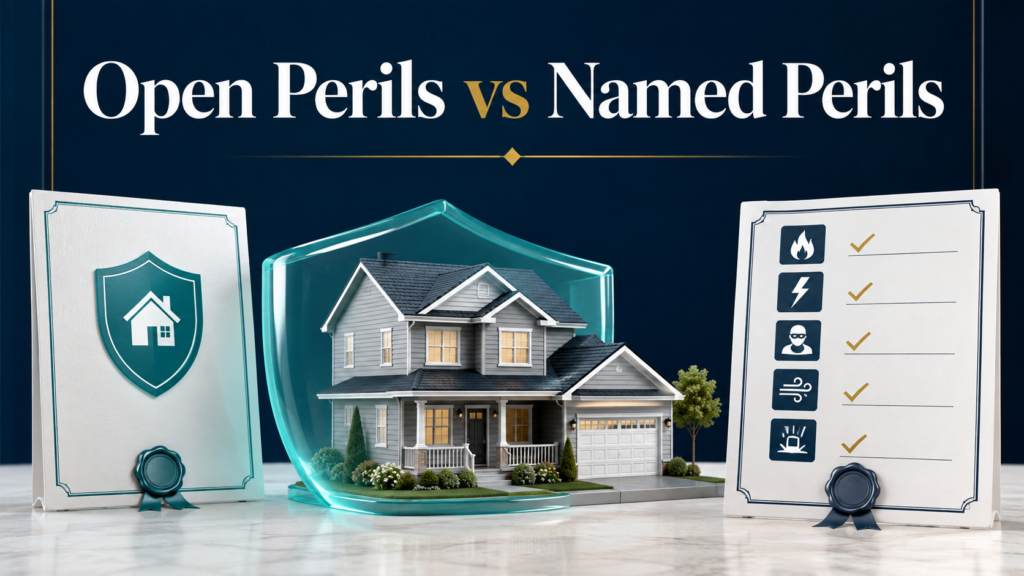
When comparing homeowners insurance policies, you may encounter two important terms: open peril and named peril. These terms determine which causes of property damage may be covered by your insurance.
The main difference is straightforward: named-perils coverage protects against only the causes of loss specifically listed in the policy, while open-perils coverage generally protects against direct physical loss unless the cause is excluded or limited.
Open-perils coverage is usually broader, but “broader” does not mean unlimited. Both types of coverage remain subject to deductibles, coverage limits, exclusions, conditions, and endorsements.
Understanding the difference can help you compare homeowners insurance quotes more accurately and avoid unpleasant surprises when filing a claim.
Open Perils vs Named Perils at a Glance
| Feature | Open-perils coverage | Named-perils coverage |
|---|---|---|
| Basic structure | Covers direct physical losses unless excluded | Covers only causes of loss listed in the policy |
| Breadth of protection | Generally broader | Generally narrower |
| How to identify coverage | Review the exclusions and limitations | Review the “Perils Insured Against” section |
| Unlisted cause of loss | May potentially be covered if not excluded | Generally not covered |
| Common policy association | Often used for dwellings under HO-3 and for dwelling and belongings under HO-5 | Often used for personal property under HO-3 and property under HO-2 |
| Premium | May cost more when other factors are comparable | May cost less |
| Best for | Homeowners wanting protection against a broader range of accidental losses | Homeowners comfortable with a defined list of covered causes |
| Still subject to exclusions? | Yes | Yes |
This table describes common policy structures. The actual policy language and endorsements determine coverage.
What Is a Peril in Homeowners Insurance?
A peril is the event or cause that produces a property loss.
Common examples include:
- Fire
- Lightning
- Windstorm
- Hail
- Theft
- Vandalism
- Smoke
- Explosion
- Falling objects
- Weight of ice, snow, or sleet
- Certain accidental water discharges
A peril is different from a hazard. A peril is the direct cause of damage, while a hazard is a condition that makes a loss more likely or more severe.
For example, fire is a peril. Faulty electrical wiring that increases the likelihood of a fire may be considered a hazard.
The National Association of Insurance Commissioners explains that homeowners coverage may insure all perils except those explicitly excluded or only the perils specifically named in the contract.
What Is Named-Perils Coverage?
A named-perils policy or coverage provision lists the causes of loss that it protects against. If the event that damaged your property is not listed, the loss generally will not be covered under that provision.
Suppose your policy names fire, theft, windstorm, and hail as covered perils. Damage caused by one of those events may qualify for coverage, subject to the policy’s exclusions, deductible, limits, and conditions.
If an unlisted event damages the property, named-perils coverage generally will not apply.
The exact list differs among policies. Some named-perils forms provide relatively broad protection, while others cover only a small number of events.
Commonly Named Perils
Depending on the policy form, named perils may include:
- Fire or lightning
- Windstorm or hail
- Explosion
- Riot or civil commotion
- Damage caused by aircraft
- Damage caused by vehicles
- Smoke
- Vandalism or malicious mischief
- Theft
- Falling objects
- Weight of ice, snow, or sleet
- Certain accidental discharges of water or steam
- Freezing of certain plumbing or household systems
- Certain sudden electrical damage
- Volcanic eruption
This is not a universal coverage list. Read the policy’s “Perils Insured Against” section instead of assuming a particular event is included.
According to the Texas Department of Insurance, named-perils policies can cover events such as fire, lightning, explosion, theft, and vandalism, but some specialized policies may protect against only one event.
What Is Open-Perils Coverage?
Open-perils coverage starts from the opposite direction. It generally covers direct physical loss unless the policy specifically excludes or limits the cause.
Open perils may also be described as:
- All-risk coverage
- Special-form coverage
- Comprehensive cause-of-loss coverage
The term “all risk” can be misleading because no homeowners insurance policy covers every possible loss. “Open perils” is a more accurate description.
The property must still be insured, the loss must fall within the insuring agreement, and no applicable exclusion or condition can eliminate coverage.
Common Open-Perils Exclusions
An open-perils policy may commonly exclude or limit losses caused by:
- Flooding
- Earth movement or earthquakes
- Wear and tear
- Deterioration
- Insects or termites
- Mold
- Rust or corrosion
- Repeated leakage
- Neglect
- Intentional damage
- War
- Nuclear hazards
- Government action
- Certain sewer or drain backups
- Faulty design, construction, or maintenance
Some of these risks may be covered through an endorsement or separate policy. For example, flood insurance is generally purchased separately, while water-backup coverage may be available as an optional endorsement.
The Texas Department of Insurance warns that open-perils policies commonly exclude losses involving floods, earthquakes, termites, wear and tear, and certain sewer-backup, mold, or foundation problems. The exact exclusions vary, so the complete policy remains controlling.
Examples of How the Two Coverage Types Work
Example 1: Fire Damage
A kitchen fire damages the home and several pieces of furniture.
- A named-perils policy may cover the loss if fire is listed as an insured peril.
- An open-perils policy may cover the loss because fire is not normally excluded.
Both claims remain subject to the applicable deductible, limits, conditions, and claim investigation.
Example 2: Accidental Damage to a Television
A television falls from its stand while furniture is being moved.
- Named-perils personal-property coverage might not apply if accidental dropping is not among the listed perils.
- Open-perils personal-property coverage may potentially apply unless the cause or circumstances are excluded.
This type of accidental loss illustrates why open-perils coverage can provide broader protection for belongings.
Example 3: Flood Damage
Rising outside water enters the home and damages the flooring and furniture.
- A named-perils homeowners policy generally will not cover the damage unless flood is specifically insured.
- An open-perils homeowners policy may still exclude flood damage.
Open-perils coverage does not override a flood exclusion. A separate flood insurance policy may be necessary.
Example 4: An Aging Roof Begins Leaking
A roof gradually deteriorates and allows water into the house.
Neither coverage type should automatically be expected to pay for the worn-out roof. Wear, deterioration, and neglected maintenance are commonly excluded.
However, resulting interior damage may be treated differently if a sudden covered event—such as wind or a falling tree—first damages the roof. Our guide to insurance coverage for roof leaks explains why the cause and timing of the damage matter.
Example 5: Theft of Jewelry
Jewelry is stolen during a burglary.
Theft may be covered under either named-perils or open-perils coverage. However, jewelry is commonly subject to special limits, documentation requirements, and exclusions.
A scheduled-personal-property endorsement may provide higher limits and broader protection for valuable items.
Does Open-Perils Coverage Make Claims Easier?
The distinction can affect what must be established during a property claim.
Under named-perils coverage, the policyholder generally needs to demonstrate that the damage resulted from a peril listed in the policy.
Under open-perils coverage, the policyholder must still demonstrate a qualifying loss to insured property. If the loss falls within the insuring agreement, the insurer may rely on an exclusion or limitation when denying coverage.
This does not mean an open-perils claim is automatically approved. Disputes may still arise regarding:
- The actual cause of damage
- Whether damage occurred suddenly or gradually
- Whether more than one cause contributed
- Maintenance and prior damage
- Policy exclusions
- Valuation of the damaged property
- Deductibles and limits
- Compliance with claim duties
Claim rules and legal burdens can vary by state, policy wording, and circumstances. Document the damage promptly and preserve receipts, photographs, inspection reports, and repair estimates.
Which Homeowners Policies Use Open or Named Perils?
A homeowners policy can use different coverage structures for the house and personal belongings.
HO-2 Policy
An HO-2, or Broad Form, generally covers the dwelling and personal property against named perils. Losses caused by events outside its specified list are generally not covered.
HO-3 Policy
An HO-3, or Special Form, commonly provides:
- Open-perils coverage for the dwelling
- Open-perils coverage for other structures
- Named-perils coverage for personal property
This means your house and belongings may have different cause-of-loss protection under the same policy.
HO-5 Policy
An HO-5, or Comprehensive Form, commonly provides:
- Open-perils coverage for the dwelling
- Open-perils coverage for other structures
- Open-perils coverage for personal property
An HO-5 is generally broader than an HO-3, particularly for personal belongings. However, it may cost more and have stricter eligibility requirements.
The NAIC’s homeowners shopping materials describe HO-2 as a named-perils form, HO-3 as generally open perils for the home but named perils for belongings, and HO-5 as generally open perils for both the home and personal property.
For a detailed policy-form comparison, see how HO-3 and HO-5 coverage differs.
HO-8 Policy
An HO-8 policy is designed primarily for certain older homes for which replacement cost may substantially exceed market value. It commonly uses named-perils coverage and modified claim-settlement provisions.
These are general descriptions of standard forms. Insurers may modify forms through endorsements or use proprietary policies with different terms.
Named Perils vs Open Perils for Personal Property
The difference is especially important for Coverage C, which protects personal belongings.
Personal property may include:
- Furniture
- Clothing
- Electronics
- Appliances
- Kitchenware
- Books
- Tools
- Household possessions
Under named-perils coverage, the damage must generally result from a listed event. Under open-perils coverage, an unusual accidental loss may potentially qualify unless excluded.
However, broader cause-of-loss coverage does not necessarily mean a larger claim payment.
You must separately examine whether belongings are settled at:
- Actual cash value: Replacement cost minus depreciation
- Replacement cost: The cost of replacing the item with a comparable new item, subject to policy requirements
Cause-of-loss coverage answers whether the event is insured. Valuation determines how the covered item is valued. These are separate provisions.
Is Open-Perils Coverage More Expensive?
Open-perils coverage may cost more because it provides protection against a broader range of accidental losses. Nevertheless, the peril structure is only one pricing factor.
Homeowners insurance premiums can also depend on:
- Location
- Rebuilding cost
- Home age and condition
- Roof age and material
- Claims history
- Coverage limits
- Deductibles
- Fire protection
- Weather and catastrophe exposure
- Credit-based insurance information where permitted
- Optional endorsements
- Discounts and underwriting rules
The Texas Department of Insurance notes that named-perils coverage can be less expensive but may not provide all the protection a homeowner needs.
Compare the actual coverage gained with the additional premium instead of selecting a policy based solely on price.
Which Coverage Is Better?
Open-perils coverage may be preferable when:
- You want broader protection against accidental property losses.
- Your belongings would be costly to replace.
- You are concerned about losses that do not fit a standard named-perils list.
- The added premium is affordable.
- You understand and accept the remaining exclusions.
Named-perils coverage may be suitable when:
- The listed perils address your primary risks.
- You prefer a lower-cost policy.
- You can financially absorb losses caused by unlisted events.
- Broader coverage is unavailable for your property.
- Selected endorsements can address your most important coverage gaps.
Open perils is broader, but the best policy is not automatically the policy with the broadest label. Limits, deductibles, exclusions, endorsements, valuation provisions, and insurer service also matter.
How to Compare Open- and Named-Perils Quotes
Before buying or renewing coverage, ask the insurer or agent for the complete policy form and endorsements.
Compare the following:
- Is the dwelling covered for named or open perils?
- Are other structures covered in the same way?
- Are personal belongings covered for named or open perils?
- Which losses are specifically excluded?
- Are flood, earthquake, wind, or water backup covered separately?
- Is claim settlement based on actual cash value or replacement cost?
- Which deductibles apply?
- Are there separate wind, hail, hurricane, or named-storm deductibles?
- What special limits apply to jewelry, cash, firearms, electronics, or business property?
- Which endorsements are included?
- What maintenance and loss-prevention duties must you follow?
- How much additional premium would broader coverage require?
Do not rely only on a quote summary or marketing description. Review the declarations, insuring agreement, exclusions, conditions, endorsements, and form numbers.
Frequently Asked Questions
What is the main difference between open perils and named perils?
Named-perils coverage protects against only the causes of loss listed in the policy. Open-perils coverage generally protects against direct physical losses unless the policy excludes or limits the cause.
Does open-perils insurance cover everything?
No. Open-perils policies still contain exclusions, conditions, deductibles, sublimits, and coverage limits. Flood, earthquake, wear and tear, deterioration, neglect, and certain water losses are commonly excluded or limited.
Is all-risk coverage the same as open-perils coverage?
The terms are commonly used interchangeably. However, “all risk” does not mean every risk is covered. Open perils is generally the more accurate term.
Is named-perils coverage bad?
Not necessarily. A named-perils policy may provide appropriate protection at a lower cost. Its suitability depends on the listed perils, exclusions, endorsements, property, location, and the homeowner’s ability to absorb uncovered losses.
Is an HO-3 an open-perils policy?
An HO-3 generally provides open-perils coverage for the dwelling and other structures but named-perils coverage for personal property. Endorsements and proprietary forms can change this structure.
Is an HO-5 open perils?
An HO-5 generally uses open-perils coverage for the dwelling, other structures, and personal property. It still contains exclusions and other coverage restrictions.
Are flood and earthquakes covered by open perils?
They are commonly excluded from standard homeowners insurance, even when the policy uses open-perils wording. Separate policies or endorsements may be necessary.
How can I tell which coverage I have?
Check the complete policy, including its “Perils Insured Against,” “Losses Insured,” and “Exclusions” sections. The declarations and form-number list can also help identify the underlying form. Ask your insurer for clarification in writing if the wording is unclear.
Final Thoughts
The open peril vs named peril distinction determines how a homeowners policy approaches covered causes of property loss.
Named-perils coverage begins with a defined list: if the cause is not listed, it generally is not covered. Open-perils coverage begins more broadly: a direct physical loss may be covered unless an exclusion or limitation applies.
Neither term tells you everything about a policy. Before choosing coverage, examine which property receives open- or named-perils protection, the exclusions, deductibles, limits, valuation method, and available endorsements.
The right policy is one that protects against your most significant risks while remaining affordable enough to maintain.
This article provides general educational information and is not insurance, legal, financial, or claims advice. Coverage depends on the complete policy, endorsements, applicable law, and facts of a loss. Consult a licensed insurance professional before purchasing or changing coverage.