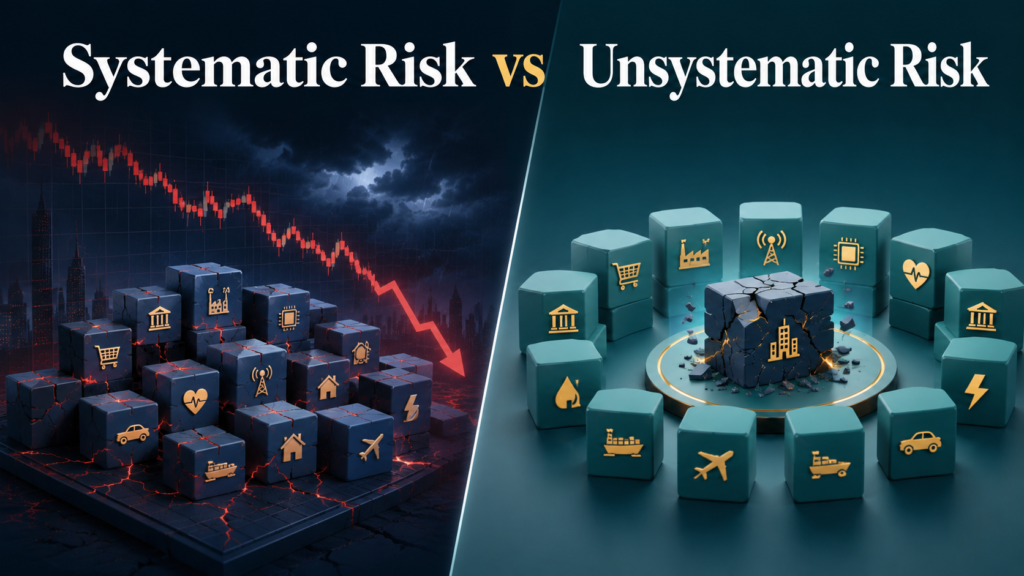
Every investment carries risk, but not every loss comes from the same source. A recession can pull down much of the stock market, while a product failure may hurt only one company. Understanding this distinction is the key to comparing systematic risk vs. unsystematic risk.
Systematic risk affects a broad market or large portion of the economy and generally cannot be eliminated through diversification. Unsystematic risk originates with a particular company, industry, or investment and can usually be reduced by holding a properly diversified portfolio.
Knowing which type of risk you are facing can help you choose more appropriate ways to manage it.
Systematic Risk vs. Unsystematic Risk at a Glance
| Factor | Systematic risk | Unsystematic risk |
|---|---|---|
| Scope | Affects the overall market or economy | Affects a company, issuer, or industry |
| Other names | Market risk, non-diversifiable risk | Specific risk, idiosyncratic risk, diversifiable risk |
| Common causes | Recessions, inflation, interest-rate changes, geopolitical shocks | Poor management, product failures, lawsuits, strikes, company bankruptcy |
| Can diversification reduce it? | It may reduce some portfolio volatility but cannot eliminate broad market risk | Yes, diversification can significantly reduce it |
| Common measurement | Beta is often used for market sensitivity | Company-specific volatility and concentration exposure |
| Primary management tools | Asset allocation, time horizon, liquidity, rebalancing | Diversification across companies, industries and issuers |
| Example | A recession causes most stocks to decline | One company’s stock falls after an accounting scandal |
The conceptual relationship is:
Total investment risk = systematic risk + unsystematic risk
This does not mean the two risks can always be added as simple dollar amounts. It means analysts commonly divide an investment’s overall uncertainty into a market-related component and an investment-specific component.
What Is Systematic Risk?
Systematic risk is the possibility of losses caused by forces affecting a large part of the financial market or economy.
These events can influence many companies simultaneously, even when those businesses have different products, management teams and financial conditions. Because the source of the risk is widespread, simply owning more stocks generally cannot make it disappear.
Common sources of systematic risk include:
- Economic recessions
- Unexpected inflation
- Significant changes in interest rates
- Financial crises
- Wars and geopolitical conflicts
- Pandemics and widespread disruptions
- Major changes in investor confidence
- Broad political or regulatory developments
For example, rising interest rates can increase borrowing costs throughout the economy. Higher rates may also reduce the present value investors assign to companies’ future earnings. As a result, many stocks can decline at the same time.
The SEC identifies market risk as a principal risk of stock funds because share prices can fluctuate for broad economic reasons as well as developments involving particular companies.
Examples of Systematic Risk
A broad economic recession
During a recession, consumers may spend less, businesses may reduce investment, unemployment may rise and corporate earnings may decline. These developments can negatively affect companies across numerous industries.
Some businesses may perform better than others, but even a diversified stock portfolio may lose value.
An unexpected inflation shock
Rapid inflation can increase companies’ costs and reduce consumers’ purchasing power. It can also lead investors to anticipate higher interest rates.
The effect is not limited to one company, making an inflation shock primarily a form of systematic risk.
A major interest-rate increase
Interest-rate changes can affect stock valuations, bond prices, borrowing costs, mortgages and corporate investment. The widespread nature of these consequences makes interest-rate risk an important market-level concern.
A global financial crisis
A severe disruption in credit markets may affect banks, businesses, consumers and governments simultaneously. Investors may sell multiple types of assets as they seek liquidity or attempt to reduce risk.
Can Systematic Risk Be Diversified Away?
Systematic risk cannot be completely diversified away because it affects many investments simultaneously.
Owning shares in 50 companies instead of one can reduce the damage caused by a single company’s failure. However, it cannot fully protect the portfolio if an economic shock causes nearly all stock prices to decline.
Diversifying across asset classes may help manage the severity of market fluctuations because stocks, bonds and cash do not always react identically. Nevertheless, no asset-allocation strategy can guarantee protection from losses.
The SEC’s investor education resources explain that diversification should occur both between asset categories and within them. They also emphasize that diversification cannot guarantee a portfolio will avoid losses when the market falls. Investor.gov explains diversification and asset allocation.
What Is Unsystematic Risk?
Unsystematic risk is the possibility of losses caused by events affecting a particular company, security, issuer or industry.
Unlike a recession or broad market collapse, the source of this risk is relatively limited. Investors can therefore reduce its effect by spreading their money among investments that are not exposed to the same company-specific problems.
Common sources of unsystematic risk include:
- A product recall
- Poor corporate management
- Accounting fraud
- A failed acquisition
- Loss of a major customer
- Supply-chain problems unique to a company
- Employee strikes
- A damaging lawsuit
- Unexpected company bankruptcy
- Industry-specific regulation
- A cybersecurity breach involving one business
Unsystematic risk is also called diversifiable, company-specific or idiosyncratic risk.
Examples of Unsystematic Risk
A company’s main product fails
Suppose a technology company invests heavily in a new product, but customers reject it. The company’s expected revenue could decline, causing its stock price to fall.
Other technology companies—and the overall market—may remain largely unaffected. The loss is therefore mainly unsystematic.
An accounting scandal
If an investigation finds that one company overstated its earnings, investors may rapidly sell its shares. Competitors without similar problems may not experience the same decline.
A factory shutdown
A fire, equipment failure or labor dispute could prevent one manufacturer from operating an important facility. The resulting loss would be specific to that business unless the disruption also affected a much broader supply chain.
Industry-specific regulation
A regulation affecting one narrow industry can represent unsystematic or industry-specific risk. However, regulation affecting most businesses or the entire economy may have a systematic component.
The boundary is not always absolute. A company can face unsystematic difficulties while broader systematic conditions intensify their consequences.
Why Diversification Affects These Risks Differently
Diversification works best against risks that do not affect every holding simultaneously.
Imagine investing $20,000 in one company. If an event causes that company’s stock to lose 50% of its value, the investment falls by $10,000.
Now imagine dividing the $20,000 equally among 20 unrelated companies. Each position represents 5% of the portfolio. If one company becomes worthless while the other holdings remain unchanged, the immediate company-specific loss would be approximately $1,000 rather than $10,000.
This simplified example demonstrates how diversification can reduce unsystematic risk.
However, if a market-wide crisis causes all 20 stocks to fall, owning more companies will not prevent a loss. Diversification may still affect the size of that loss, but systematic risk remains.
Investors should consequently avoid assuming that a portfolio is diversified merely because it contains several investments. Holdings can still be highly correlated or concentrated in the same industry. FINRA recommends examining both individual positions and the underlying holdings of mutual funds or ETFs to identify hidden concentration and overlap. FINRA’s concentration-risk guidance provides additional details.
If you plan to select individual securities, our guide to reducing company-specific concentration through diversification explains why the number of holdings is only one part of portfolio construction.
How Beta Relates to Systematic Risk
Beta is commonly used to estimate how sensitive an investment has historically been to movements in a particular market benchmark.
A simplified interpretation is:
- Beta of 1.0: The investment has historically shown benchmark-like sensitivity.
- Beta above 1.0: The investment has historically been more sensitive to benchmark movements.
- Beta below 1.0: The investment has historically been less sensitive.
- Negative beta: The investment has sometimes moved in the opposite direction, although consistently negative betas are uncommon.
For example, a stock with a beta of 1.3 may be described as having greater market sensitivity than a stock with a beta of 0.8.
Beta does not predict exactly how much an investment will gain or lose. It is calculated from historical relationships, depends on the selected benchmark and time period, and does not capture every type of risk.
A low-beta company could still suffer a severe loss because of fraud, bankruptcy or another unsystematic event. Beta should therefore be treated as one analytical measure—not a complete risk assessment.
Systematic Risk Is Not the Same as Systemic Risk
The terms sound similar but can have different meanings.
- Systematic risk refers to broad market risk that cannot be eliminated through ordinary diversification.
- Systemic risk usually refers to the danger that the failure or disruption of one important institution or market component could spread through the financial system.
A recession-driven decline across the stock market is an example of systematic risk. The collapse of a deeply interconnected financial institution that threatens the functioning of the wider banking system may create systemic risk.
Some educational sources use the terms less strictly, so readers should check how an author defines them.
How to Manage Systematic Risk
Systematic risk cannot be eliminated, but investors can take steps to manage their exposure.
Choose an appropriate asset allocation
Asset allocation determines how a portfolio is divided among investments such as stocks, bonds and cash.
The appropriate allocation depends on financial objectives, investment horizon, liquidity needs and ability to tolerate losses. Different asset classes may respond differently to economic developments, although these relationships can change.
Maintain an adequate time horizon
Money needed soon generally should not depend heavily on investments that can experience substantial short-term losses.
Longer horizons may provide more time to recover from market declines, but recovery is never guaranteed.
Keep sufficient emergency liquidity
An emergency fund may reduce the likelihood that an investor will need to sell long-term assets during a market downturn.
Limit unnecessary leverage
Borrowing to invest can magnify gains, but it also magnifies losses. A market decline may force a leveraged investor to sell assets or provide additional collateral.
Rebalance periodically
Market movements can cause a portfolio to drift away from its intended allocation. Rebalancing returns holdings toward their target proportions and can prevent one category from becoming unintentionally dominant.
Before establishing an allocation, consider how you assess your willingness and capacity to accept investment losses.
How to Manage Unsystematic Risk
Diversify across companies
Avoid allowing the financial health of one company to determine the outcome of the entire portfolio.
Diversify across industries
Owning several stocks in one industry may still create significant concentration risk. Companies in the same sector can be exposed to similar regulations, commodity prices or consumer trends.
Examine fund holdings
Owning several funds does not necessarily produce diversification. Two funds may hold many of the same large companies or track similar indexes.
Investors using funds can review our discussion of how to build diversification with exchange-traded funds.
Set reasonable position limits
Position limits can prevent one successful investment from growing into an excessively large percentage of a portfolio.
Review employer-stock exposure
Employees who hold substantial stock in their employer may face two related risks: their job and investment could both be harmed if the company encounters financial trouble. FINRA specifically warns that excessive company-stock exposure can create this form of concentration risk. FINRA’s company-stock guidance explains the concern.
Reassess the investment thesis
Diversification should not replace basic research. Investors should periodically reconsider whether the original reasons for owning an investment still apply.
Which Type of Risk Matters More?
Both matter, but their importance depends on the portfolio.
An investor holding one or two individual stocks may have substantial systematic and unsystematic risk. A broadly diversified stock-index portfolio may contain relatively little company-specific risk, but it can still experience significant losses during a market downturn.
For many long-term investors, avoiding unnecessary unsystematic risk is a reasonable priority because it is the type diversification can most directly reduce. Accepting some systematic risk, meanwhile, is generally part of seeking returns from market investments.
The objective is not to make a portfolio completely risk-free. That is not possible. Instead, investors can avoid taking concentrated risks that are unnecessary for achieving their goals.
Common Mistakes to Avoid
Assuming more holdings always means more diversification
Twenty companies in one narrow industry may be less diversified than a smaller collection spread across unrelated sectors.
Believing an ETF eliminates all risk
An ETF may provide broad diversification, but a narrowly focused sector, country or thematic ETF can still be concentrated. Mutual funds and ETFs can also decline when the overall market falls.
Investor.gov notes that mutual funds are not guaranteed or insured by the FDIC and that investors may lose some or all of the money invested. Investor.gov’s mutual-fund overview describes these risks.
Using beta as a complete risk score
Beta focuses on market sensitivity. It does not fully measure liquidity, credit, valuation, business or company-specific risk.
Reacting emotionally to every market movement
Market volatility does not necessarily mean a long-term plan has failed. Decisions should be evaluated in the context of financial goals, time horizon and personal risk capacity.
Ignoring overlapping investments
A person may own an individual stock directly and indirectly through several funds. Reviewing underlying holdings can reveal exposure that is larger than it initially appears.
Frequently Asked Questions
What is the main difference between systematic and unsystematic risk?
Systematic risk affects a large part of the market or economy, while unsystematic risk affects a particular company, issuer or industry. Diversification can reduce unsystematic risk but cannot eliminate broad market risk.
Can systematic risk be completely avoided?
No. Investors can manage their exposure through asset allocation, liquidity, time horizon and other methods, but market-wide risk cannot be completely eliminated from investments exposed to financial markets.
Is inflation a systematic risk?
Unexpected inflation is generally considered a systematic risk because it can affect interest rates, consumer purchasing power, company expenses and valuations across many areas of the economy.
Is company bankruptcy an unsystematic risk?
A bankruptcy caused by problems unique to one company is primarily unsystematic. A widespread economic crisis may increase bankruptcy risk across the market, adding a systematic element.
Do mutual funds eliminate unsystematic risk?
A broadly diversified fund may substantially reduce company-specific risk, but it may not eliminate it completely. Narrow or concentrated funds can retain significant industry, geographic or issuer-specific exposure.
Does diversification prevent investment losses?
No. Diversification can reduce concentration risk and may limit the effect of an individual investment’s failure, but it does not guarantee a profit or protect a portfolio from every market decline. Investor.gov expressly notes that diversified investments may still suffer when the overall market falls. Investor.gov’s diversification guidance explains this limitation.
Final Thoughts
The essential difference in systematic risk vs. unsystematic risk is the source and scope of the threat.
Systematic risk comes from broad economic or market forces and remains even in a diversified portfolio. Unsystematic risk comes from individual companies, issuers or industries and can often be reduced by spreading investments across different holdings.
Diversification is therefore valuable, but it is not a shield against every loss. A well-considered portfolio combines diversification with appropriate asset allocation, liquidity, realistic expectations and a risk level consistent with the investor’s financial circumstances.
This article is for educational purposes only and does not constitute personalized investment, tax or legal advice. All investments involve risk, including the possible loss of principal.