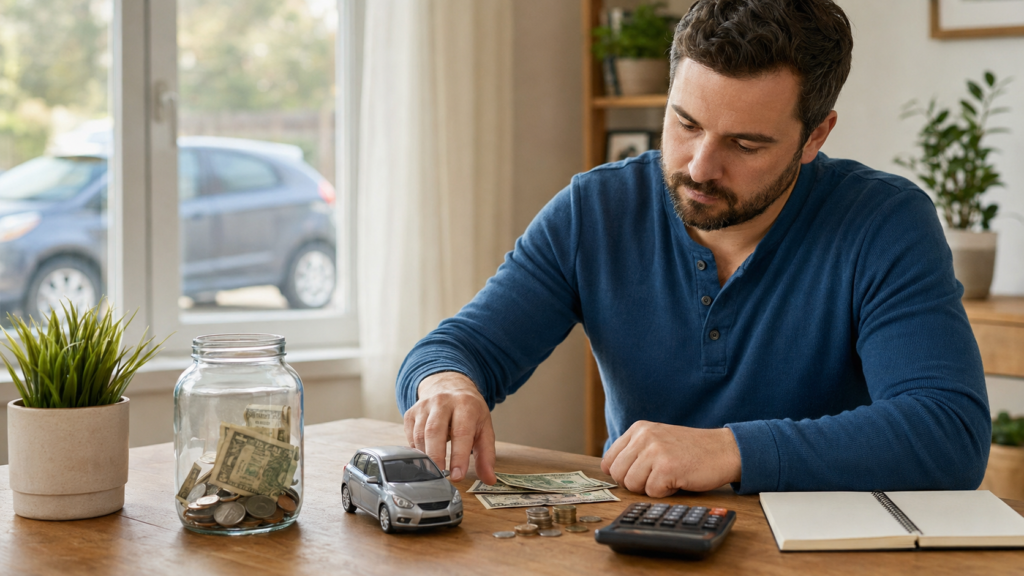
Saving for a car can feel difficult when prices, insurance premiums, registration fees, and repair costs all compete for your money.
The process becomes more manageable when you turn the purchase into a specific savings target. Instead of simply deciding to “save for a car,” determine what type of vehicle you need, how much you can reasonably afford, when you want to buy it, and which additional costs must be covered.
A practical car savings plan follows this formula:
Amount to save = Total purchase costs − current savings − trade-in proceeds − planned financing
You can then divide the result by the number of months or paychecks before your target purchase date.
This guide explains how to save money for a car without overlooking the costs that often surprise buyers.
1. Decide What You Need From the Car
Begin with your transportation needs rather than a particular make, model, or monthly payment.
Consider questions such as:
- How many people will regularly use the vehicle?
- How far will you drive each week?
- Will you use it primarily for commuting?
- Do you need additional cargo space?
- Is fuel economy particularly important?
- Do weather or road conditions require specific features?
- Can you keep your current vehicle longer?
- Would a reliable used car meet your needs?
Separate required features from preferences.
For example, reliable transportation, acceptable safety ratings, and sufficient passenger space may be requirements. A premium sound system, leather seats, or a particular exterior color may be preferences.
This distinction can prevent optional features from increasing your savings target or future loan payment.
2. Set an Affordable Total Car Budget
The advertised price is not the complete cost of buying and owning a car.
Your initial target may need to include:
- Vehicle purchase price
- Sales tax
- Title and registration fees
- Documentation or dealer fees
- Independent inspection
- Immediate maintenance or repairs
- Initial insurance payment
- Down payment
- Optional products you deliberately select
Taxes and government fees vary by state and location, so research the costs that apply where you live.
You should also estimate ongoing ownership expenses:
- Insurance
- Fuel or charging
- Routine maintenance
- Repairs
- Registration renewals
- Parking
- Tolls
- Loan payments and interest
A car that fits your purchase budget may still be unaffordable if its insurance, fuel, or repair costs are too high.
Do not budget from the monthly payment alone
A dealer may be able to lower a monthly payment by extending the loan term. However, a longer term can increase the total interest paid and may leave you owing money on the vehicle for longer.
The Consumer Financial Protection Bureau recommends comparing interest rates and loan terms before buying. It also notes that several parts of an auto loan can be negotiable. Its auto-loan resources and comparison tools can help you evaluate offers.
When comparing vehicles or loans, review:
- Vehicle price
- Down payment
- Amount financed
- Annual percentage rate
- Loan length
- Monthly payment
- Total of all payments
- Optional add-ons
- Total interest cost
3. Choose Between Paying Cash and Financing
You do not necessarily need to save the car’s entire price before buying it.
Your target will depend on whether you plan to:
- Pay the full price in cash
- Save a down payment and finance the balance
- Combine savings with the sale or trade-in of your current vehicle
Paying cash
Paying cash avoids an auto loan and its interest charges. However, it may require a longer savings period.
Do not empty your emergency savings simply to avoid financing. A vehicle can need repairs shortly after purchase, and unrelated emergencies can still occur.
Making a down payment
A larger down payment generally reduces the amount you must borrow. It may also reduce your monthly payment and total interest cost.
There is no single down-payment percentage that fits every buyer. The appropriate amount depends on:
- Your available savings
- Vehicle price
- Loan rate and term
- Credit profile
- Monthly cash flow
- Emergency fund
- Value of your current vehicle
Calculate several scenarios before deciding. Compare the total borrowing cost rather than assuming a particular percentage is automatically correct.
4. Calculate Your Complete Savings Target
Use the following worksheet to estimate how much you need:
| Item | Estimated amount |
|---|---|
| Vehicle price | $______ |
| Sales tax | $______ |
| Title and registration | $______ |
| Dealer or documentation fees | $______ |
| Pre-purchase inspection | $______ |
| Immediate repairs or maintenance | $______ |
| Initial insurance cost | $______ |
| Total expected cost | $______ |
| Less current car savings | − $______ |
| Less trade-in or sale proceeds | − $______ |
| Less planned financing | − $______ |
| Amount still needed | $______ |
Get an insurance quote for the specific type of car you are considering. Premiums can vary substantially among vehicles and drivers.
If you are buying used, include money for an independent inspection and possible initial maintenance. Even a car that appears affordable can strain your finances if you have no money left for tires, fluids, brakes, or another early repair.
5. Select a Realistic Purchase Date
Your deadline determines the amount you must save each month.
Use this formula:
Suppose your target is $12,000 and you already have $2,000:
$12,000−$2,000=$10,000\$12,000-\$2,000=\$10,000
If you want to buy the car in 20 months:
$10,000÷20=$500\$10,000\div20=\$500
You would need to save $500 per month.
If $500 does not fit your budget, you have four main options:
- Choose a less expensive vehicle
- Extend the deadline
- Increase your income
- Combine savings with carefully evaluated financing
Do not choose a deadline that requires you to miss essential bills or accumulate credit card debt.
Car Savings Examples
The following examples illustrate different purchase strategies. Taxes, fees, loan rates, and other costs will vary.
Example 1: Saving cash for a $10,000 used car
Assume the buyer estimates:
| Item | Amount |
|---|---|
| Vehicle price | $10,000 |
| Taxes, title, and registration | $900 |
| Inspection and initial maintenance | $600 |
| Initial insurance cost | $500 |
| Total target | $12,000 |
| Current savings | −$2,000 |
| Remaining amount | $10,000 |
Saving the remaining amount over 20 months requires:
$10,000÷20=$500 per month\$10,000\div20=\$500\text{ per month}
Example 2: Saving a down payment for a $20,000 car
Suppose the estimated total purchase cost is $22,500. The buyer wants to save $7,500 before financing the remaining amount.
If $1,500 is already saved:
$7,500−$1,500=$6,000\$7,500-\$1,500=\$6,000
Over 24 months:
$6,000÷24=$250 per month\$6,000\div24=\$250\text{ per month}
The buyer should still compare loan rates, terms, and total payments before proceeding.
Example 3: Saving toward a $30,000 car
Suppose the buyer wants $10,000 available for the down payment and other initial expenses.
With $1,000 already saved and a 36-month deadline:
($10,000−$1,000)÷36=$250 per month(\$10,000-\$1,000)\div36=\$250\text{ per month}
This plan is more manageable than attempting to save the same amount in one year, but the buyer must still determine whether the eventual loan and ownership costs fit the household budget.
6. Keep the Car Fund Separate
A car purchase is a planned expense, so its savings should generally be separate from your emergency fund.
A dedicated car fund can be held in a savings account or another safe, accessible account appropriate for your timeframe. The account should not expose near-term car money to substantial investment risk.
The distinction is:
- Car fund: Money for the planned purchase
- Emergency fund: Money for unexpected financial disruptions
- Repair fund: Money for maintenance and repairs after purchasing the vehicle
Our comparison of a sinking fund and an emergency fund explains how to keep planned and unexpected expenses separate.
If you have no financial reserve, consider building a modest emergency savings fund while saving for the car. Otherwise, an unrelated emergency may force you to spend the entire car fund.
7. Automate Your Car Savings
Schedule an automatic transfer shortly after each payday.
If your monthly target is $300 and you are paid twice per month, transfer:
$300÷2=$150 per paycheck\$300\div2=\$150\text{ per paycheck}
If you receive 26 biweekly paychecks each year, convert an annual target into a per-paycheck amount:
Amount per biweekly paycheck = Annual savings target ÷ 26
For example, to save $6,000 in one year:
$6,000÷26=$230.77\$6,000\div26=\$230.77
You would need to save approximately $231 from each paycheck.
If your normal monthly budget is built around two paychecks, you may also be able to put part of the two additional annual checks toward the car. Our guide to budgeting biweekly paychecks explains how to handle those three-paycheck months.
Start with an amount your account can support without causing overdrafts. A smaller automatic transfer you can maintain is more useful than an aggressive amount you repeatedly cancel.
8. Create a 12-, 24-, or 36-Month Plan
The following table shows the monthly amount required for several savings targets:
| Savings target | 12 months | 24 months | 36 months |
|---|---|---|---|
| $3,000 | $250 | $125 | $83.33 |
| $5,000 | $416.67 | $208.33 | $138.89 |
| $7,500 | $625 | $312.50 | $208.33 |
| $10,000 | $833.33 | $416.67 | $277.78 |
| $15,000 | $1,250 | $625 | $416.67 |
These figures assume you are starting from zero and do not include interest earned.
If the required amount is too high, extending the deadline from 12 to 24 months can reduce the monthly target by half. The tradeoff is continuing to use your current transportation for longer.
9. Find Money for the Car Fund
Review your actual spending before cutting expenses. A monthly budget based on real transactions can show what is available after necessities and required payments.
Possible ways to increase car savings include:
- Canceling unused subscriptions
- Reducing restaurant and delivery spending
- Comparing insurance and phone plans
- Selling items you no longer use
- Directing tax refunds or bonuses to the fund
- Saving part of overtime or side income
- Reducing the planned vehicle price
- Keeping your current car longer
- Redirecting money after paying off another obligation
Avoid reducing essential insurance, missing debt payments, or eliminating all discretionary spending. A savings plan is more likely to succeed when it remains realistic for the entire timeline.
How to Save Money for a Car With Low Income
Saving for a car can take longer when housing, food, utilities, and healthcare already use most of your income.
Begin with a dependable baseline amount—even if it is only $10 or $20 per paycheck. Then add irregular amounts whenever they become available.
Prioritize the following:
- Choose a reliable vehicle rather than a status-oriented one.
- Extend the deadline to lower the required monthly amount.
- Research insurance costs before selecting a model.
- Direct refunds, gifts, or occasional extra income to the car fund.
- Avoid loans with unaffordable terms merely to buy sooner.
- Maintain a small emergency buffer.
- Consider the cost of transportation alternatives while saving.
If your budget has little flexibility, our guide to budgeting on a low income can help you prioritize necessities without relying on unrealistic percentage rules.
10. Estimate Your Current Car’s Value Carefully
If you plan to sell or trade in a current vehicle, get several estimates rather than relying on one offer.
Your usable equity is:
Vehicle value−outstanding loan balance\text{Vehicle value}-\text{outstanding loan balance}
For example, if the car is worth $8,000 and you owe $5,500:
$8,000−$5,500=$2,500\$8,000-\$5,500=\$2,500
You may have approximately $2,500 of positive equity before transaction-related costs.
If you owe more than the vehicle is worth, you have negative equity. Rolling that balance into a new loan increases the amount financed and may make the next car significantly more expensive.
Do not count the entire estimated sale price toward your savings target if a loan must first be repaid.
11. Check a Used Car Before Buying
Saving successfully does not protect you from purchasing the wrong vehicle.
Before buying a used car:
- Review its maintenance history when available.
- Obtain a vehicle history report.
- Arrange an independent mechanical inspection.
- Test drive the vehicle.
- Check the tires, lights, fluids, and major controls.
- Confirm the title status.
- Review warranty terms in writing.
- Check the VIN for open safety recalls.
- Understand whether the vehicle is sold “as is.”
The Federal Trade Commission explains that dealers must display a Buyers Guide on used vehicles. It identifies whether the vehicle is sold with a warranty or “as is” and encourages buyers to obtain an independent inspection. The FTC also warns that a vehicle history report is not a substitute for a mechanical inspection. See its guidance on buying a used car from a dealer.
You can enter the 17-character VIN into the NHTSA recall lookup tool to check for unrepaired safety recalls.
Include inspection costs in your car fund rather than skipping the inspection to remain within the purchase budget.
12. Compare Financing Before Visiting the Dealer
If you plan to finance part of the purchase, research loan options before negotiating the vehicle.
Consider checking:
- Banks
- Credit unions
- Online lenders
- Dealer financing
Compare offers for the same loan amount and term. A low advertised rate may be available only to buyers who meet specific credit requirements.
Review all paperwork before signing. Confirm that the contract matches the price, down payment, interest rate, term, trade-in value, and optional products you accepted.
Optional add-ons can substantially increase the amount financed. The FTC notes that products such as service contracts, gap coverage, VIN etching, and rustproofing may be offered late in the transaction. Request the price of each item and decline products you do not want.
A Copyable Car Savings Plan
Use this template to create your plan:
Vehicle goal
- New or used: ______
- Target vehicle type: ______
- Estimated vehicle price: $______
- Estimated purchase costs: $______
- Inspection and initial maintenance: $______
- Initial insurance cost: $______
- Total expected cost: $______
Available resources
- Current car savings: $______
- Expected sale or trade-in equity: $______
- Planned financing: $______
- Remaining savings target: $______
Timeline
- Target purchase date: ______
- Number of months remaining: ______
- Monthly savings required: $______
- Amount per paycheck: $______
Savings sources
- Automatic payday transfer: $______
- Expected extra-paycheck contribution: $______
- Bonus or refund contribution: $______
- Side-income contribution: $______
- Other: $______
Review the plan once per month. Update the vehicle price, insurance estimate, timeline, and savings contribution if your circumstances change.
Common Car-Saving Mistakes
Saving only for the advertised price
Taxes, registration, insurance, inspection, and immediate maintenance can create a shortage at the time of purchase.
Choosing a car by monthly payment
A low payment may conceal a longer loan term or higher total borrowing cost.
Using the entire emergency fund
Buying the car may leave you unable to handle a repair, medical bill, or income disruption.
Counting an estimated trade-in value as guaranteed
The actual offer may be lower, and an outstanding loan reduces the equity available.
Investing short-term car money aggressively
Money needed soon may lose value at the wrong time. Match the account and level of risk to the purchase deadline.
Buying before obtaining an insurance quote
A vehicle with a manageable price may have an unexpectedly expensive premium.
Skipping the independent inspection
A history report may not reveal current mechanical problems.
Saving without a specific deadline
A clear date and contribution amount make progress easier to measure.
Frequently Asked Questions
How much should I save for a car?
Calculate the vehicle price plus taxes, registration, insurance, inspection, and likely initial maintenance. Subtract existing savings, positive trade-in equity, and any amount you deliberately plan to finance. The result is your personal savings target.
How long does it take to save money for a car?
Divide the remaining target by the amount you can save each month. Saving $400 per month toward an $8,000 target would take approximately 20 months, excluding interest earned.
Where should I keep my car savings?
For a purchase planned within the next few years, consider a safe, accessible account that keeps the money separate from everyday spending. Compare fees, withdrawal rules, deposit insurance, and current yields before choosing an account.
Should I save for a car or pay off debt first?
The answer depends on the urgency of your transportation need, the cost of your debt, and your available cash. Continue required payments and protect essential expenses. If you urgently need reliable transportation for work, you may need to save for a modest car while paying debt. If the purchase can wait, expensive debt may deserve greater priority.
Is it better to buy a new or used car?
Neither option is automatically best. Compare purchase price, insurance, financing, reliability, expected repairs, warranty coverage, depreciation, and how long you plan to keep the vehicle. A well-inspected used car may cost less, while a new car may include stronger warranty protection but have a higher purchase price.
Can I use my emergency fund to buy a car?
A planned car purchase is normally not an emergency. Using the entire emergency fund could leave you financially exposed. If your current vehicle suddenly becomes unusable and transportation is essential, circumstances may require using part of the fund, but preserve a reasonable buffer when possible.
How can I save for a car faster?
Reduce the target price, extend the life of your current vehicle, automate transfers, sell unused belongings, direct windfalls to the fund, or temporarily add income. Avoid speeding up the purchase by accepting financing you cannot comfortably repay.
Final Thoughts
Learning how to save money for a car begins with calculating the full cost—not merely the advertised price.
Choose a vehicle based on your transportation needs, estimate taxes and initial expenses, get an insurance quote, and decide how much you will pay in cash. Then subtract existing savings and positive trade-in equity before dividing the remaining target by your available months or paychecks.
Keep the money in a dedicated car fund, automate contributions, and review your progress regularly. When it is time to buy, compare financing carefully and have a used vehicle independently inspected.
A car savings plan may take longer than expected, but arriving at the dealership with a clear budget and money already reserved gives you far more control over the purchase.
This article is for general educational purposes only and does not constitute individualized financial, legal, tax, insurance, or credit advice. Consider consulting appropriately qualified professionals regarding your circumstances